
Concrete Floor Grinding vs. Shot Blasting: Which Prep Method Does Your OKC Facility Need?
When you walk into a beautifully finished commercial facility, a high-tech manufacturing plant, or a sleek retail showroom right here in Oklahoma City, your eyes naturally gravitate toward the floor. Whether it is a flawless, glossy epoxy coating, a rugged industrial overlay, or a polished architectural finish, a great floor leaves a massive impression. But here is the industry’s biggest open secret: the beauty and longevity of that floor have very little to do with the topcoat itself. Instead, it relies almost entirely on what happened to the bare concrete slab before the first drop of paint or resin was ever mixed.
In the commercial construction and remodeling worlds, failing to focus on proper surface prep is the single fastest way to guarantee a catastrophic flooring failure. If the substrate isn’t handled correctly, your expensive new floor system will eventually blister, crack, peel, and delaminate, turning your major property investment into a costly nightmare.
When it comes to preparing commercial concrete slabs within a 50-mile radius of OKC, two mechanical heavyweights dominate the conversation: concrete floor grinding and shot blasting. Both methods are designed to clean, level, and texture concrete, but they do so using completely different mechanics, timelines, and budgets. Choosing the incorrect path can ruin your new floor’s adhesion or unnecessarily inflate your project timeline. Let’s break down the exact mechanics of diamond grinding versus shot blasting so you can make an informed, actionable decision for your facility.
The Absolute Necessity of Concrete Surface Prep
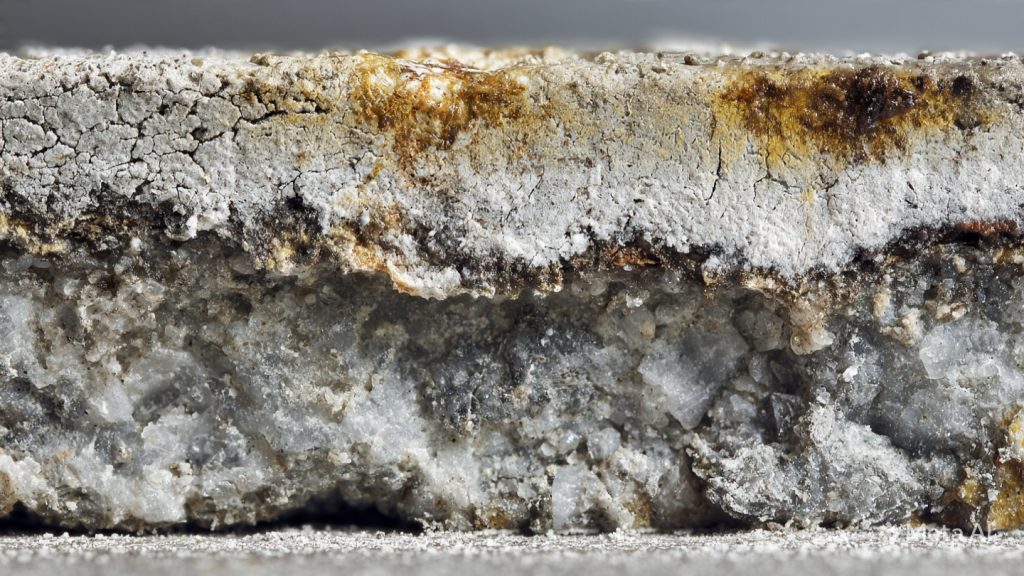
Before diving into the equipment, we must understand what we are trying to achieve during slab preparation. New or old, raw concrete is rarely ready to receive a high-performance coating or overlay. Slabs are naturally plagued by surface contaminants like dirt, grease, old sealers, curing compounds, and a weak, powdery top layer of concrete known as laitance. Laitance forms as excess water bleeds to the surface during the concrete curing process. If you apply an epoxy or urethane directly over laitance, the coating will bond to the weak powder rather than the strong concrete structure underneath. Under traffic stress, that powder breaks away, causing the entire floor to peel.
Thorough concrete surface prep strips away this weak layer, exposes sound concrete aggregates, opens up the microscopic pores of the slab, and profiles the surface. This mechanical profiling gives liquid coatings a microscopic “tooth” to grip onto. Without this physical bond, the system relies strictly on chemical stickiness, which inevitably fails under heavy foot or vehicle traffic. Effective subfloor prep eliminates installation risks and maximizes the lifespan of your property’s surfaces.
Understanding Concrete Floor Grinding: Precision and Finesse
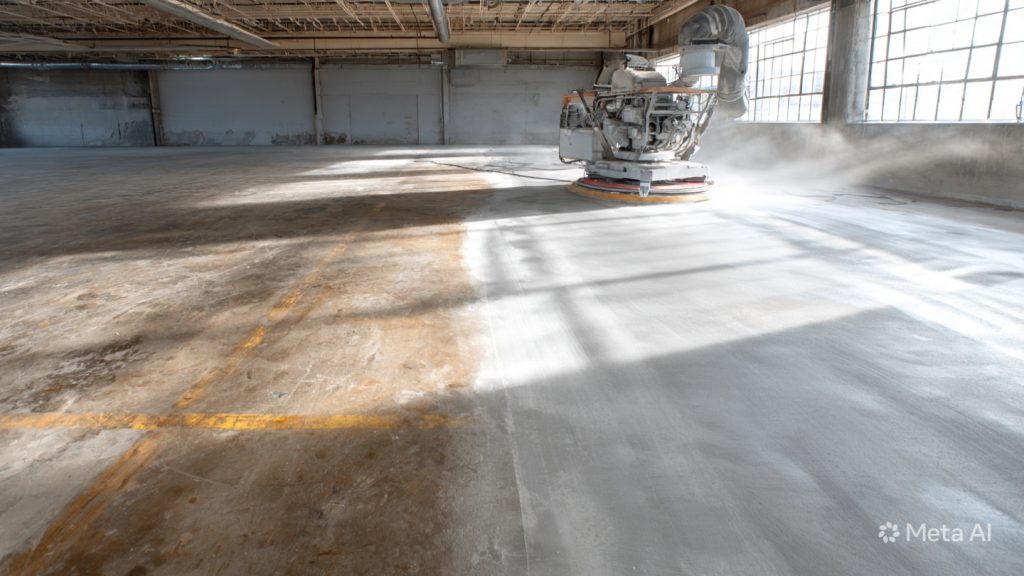
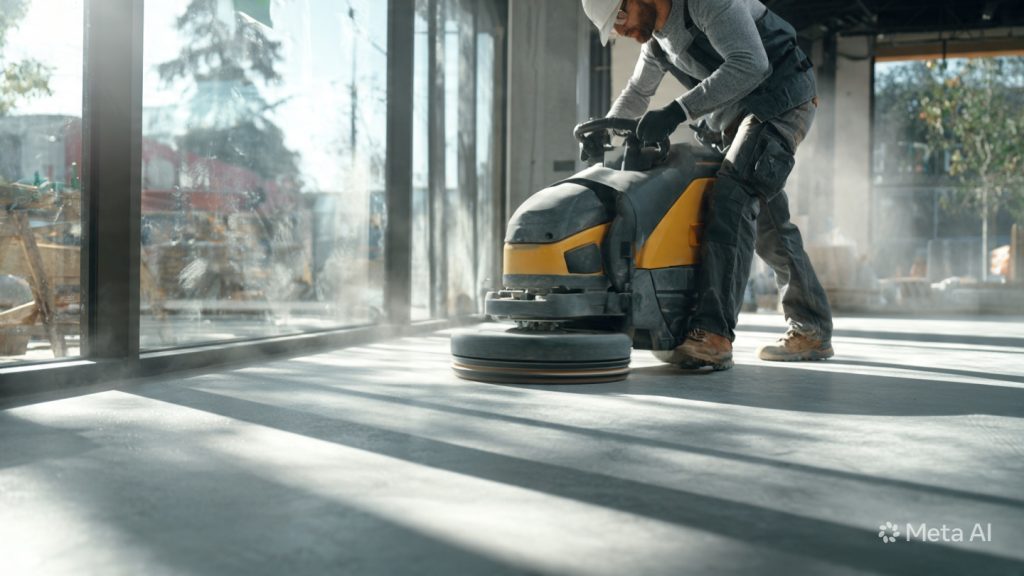
If your upcoming commercial renovation requires absolute precision, flatness, and structural smoothness, floor grinding is usually the gold standard. This mechanical process utilizes heavy-rotating planetary or rotary machines equipped with industrial diamond-segmented abrasive discs. As these diamonds spin across the slab under intense, controlled downward pressure, they gently shave away imperfections, smooth out high spots, and open up the pores of the concrete.
Benefits of Diamond Grinding Concrete
- Incredible Leveling Control: Grinding excels at flattening wavy concrete slabs, correcting uneven joints, and eliminating trip hazards on walkways or interior facility floors.
- Finesse and Smoothness: It creates a relatively smooth, highly consistent surface profile, typically categorized as a Concrete Surface Profile (CSP) 1 to 3. This makes it the ideal choice for thin-film coatings, stains, sealers, and projects prepping for polished concrete.
- Superb Dust Containment: Modern industrial grinding systems are fully paired with high-performance, OSHA-compliant HEPA dustless grinding vacuums. This ensures that the entire process is practically dust-free, allowing nearby commercial operations to continue safely without airborne contamination.
- Tight Space Versatility: Walk-behind and handheld diamond grinders can maneuver directly into tight corners, along walls, and around structural columns where larger equipment simply cannot reach.
Limitations of the Grinding Method
While diamond grinding concrete offers unmatched control, it is inherently a slower, more deliberate process compared to high-impact blasting techniques. It usually covers anywhere from 500 to 1,000 square feet per hour depending on the hardness of the slab. Additionally, if you are dealing with thick, rubbery, or highly elastic existing materials, traditional diamond pads can generate friction heat, causing old glues or thick coatings to melt and gum up the diamonds rather than clean off cleanly.
Decoding Concrete Shot Blasting: High-Impact Speed and Power
When your project demands massive production speeds, aggressive texturing, and the deep removal of stubborn materials across thousands of square feet, a professional shot blasting service is the ultimate solution.
A shot blaster is a high-velocity, self-contained machine that utilizes a high-speed centrifugal wheel to forcefully propel thousands of tiny steel balls (known as steel shot) directly down into the concrete surface. This intense impact literally fractures away the brittle top layer of laitance, old coatings, and embedded contaminants on a microscopic scale.
Crucially, the machine operates as a continuous closed-loop system: immediately after the steel shot strikes the ground, an integrated high-powered vacuum sucks the shot, concrete dust, and debris back up into the unit. The heavy steel shot is separated and recycled back to the blast wheel, while the dust is safely deposited into a containment collector.
Benefits of a Shot Blasting Service
- Blazing Fast Production Speeds: Shot blasting is incredibly fast, capable of preparing 1,500 to 3,000 square feet per hour. Large-scale industrial setups can easily prep 20,000 to 30,000 square feet in a single working shift.
- Aggressive Mechanical Anchoring: It creates a deeply textured, highly porous surface profile (typically CSP 3 to 5+). This rough profile provides the ultimate mechanical anchor required for high-build industrial coatings, self-leveling underlayments, and heavy-duty urethane cement mortars.
- Deep Contaminant Elimination: Because it fractures the top layer of concrete, it strips away deeply embedded grease, oils, tire marks, and chemical residues that superficial cleaning or light grinding might leave behind.
When Shot Blasting Isn't Ideal
Because shot blasting works via high-impact fracturing, it does not level out wavy concrete or remove high spots. Instead, the machine follows the exact contour of your existing slab, meaning an uneven floor will remain uneven after blasting. It also leaves a distinct, track-lined, textured finish. If you were to apply a very thin, clear sealer directly over a shot-blasted floor, the aggressive texture and blasting tracks would visibly “telegraph” right through the finished system, ruining the aesthetic appeal. Lastly, shot-blasting units are large and cannot get completely flush against walls or tight corners, meaning a professional team must always perform edge grinding separately to finish the perimeter.
Other Crucial Methods: Scarifying Concrete and Floor Leveling
While diamond grinding and shot blasting handle the majority of commercial projects, certain extreme slab conditions require alternative heavy-duty machinery.
When faced with thick, failing epoxy mortars, thick layers of rubberized waterproof membranes, or severely deteriorated concrete surfaces, a concrete scarification service is called into action. Scarifiers (also called milling machines or multi-plane machines) use rows of rotating, toothed cutter wheels assembled on a spinning drum to aggressively chip, scarify, and grooved-cut into the concrete. Scarifying concrete creates an extremely deep profile (CSP 5 to 7+) and removes significant depth from the slab, making it perfect for major structural restoration.
Conversely, if your subfloor suffers from severe low spots, structural settling, or drainage issues, the focus shifts toward concrete floor leveling. Following an initial grind to clean the slab, specialized self-leveling underlayments are mixed and poured across the floor to create a perfectly flat, level plane. Achieving precise concrete leveling is vital before installing large-format tiles, luxury vinyl planks, or hardwood floors to prevent future shifting and joint failure.
Tackling Stubborn Contaminants: Coating Removal and Adhesive Scraping
In renovation and commercial remodel projects, you are rarely dealing with a clean, unblemished piece of virgin concrete. Instead, crews usually have to tear out old, outdated flooring systems before they can even think about the new design. This phase of construction is known as floor demo and floor covering removal.
Once the old carpet, vinyl tile, or ceramic panels are pulled up, the real work begins. Slabs are routinely left coated in sticky, stubborn layers of black mastic, dried thinset mortar, or old yellow carpet glue. Attempting to install a new flooring system directly over old adhesive residues is a recipe for instant bonding failure.
To solve this, specialized coating removal strategies are deployed. For instance, tile removal projects leave behind ridges of hardened cementitious mortar that require a specialized thinset grinding service. This process utilizes heavy planetary grinders equipped with aggressive PCD (polycrystalline diamond) segments or bush hammer attachments that physically shatter and scrape away the brittle thinset without gouging the structural concrete subfloor beneath.
For projects involving old resinous systems, epoxy removal or floor paint removal requires a strategic blend of diamond grinding or shot blasting to completely strip away the old polymeric bond. This step transitions the floor from an oil-stained, glue-covered mess into a bond-ready, completely clean concrete substrate.
The Golden Rule: Matching Your Floor Coating to the Concrete Surface Profile (ICRI CSP)
To guarantee a flawless installation, your floor preparation company must carefully coordinate the mechanical prep method with the technical requirements of the new flooring material. The International Concrete Repair Institute (ICRI) has established ten distinct Concrete Surface Profile (CSP) classifications, ranging from CSP 1 (nearly smooth) to CSP 10 (extremely rough).
As a general rule of thumb, thinner flooring systems require lower, smoother CSP numbers, while thick, heavy-duty industrial systems require high, aggressive CSP textures:
- Sealers, Stains, and Polished Concrete (CSP 1–2): Require a light, uniform finish. This is achieved almost exclusively through fine-grit diamond grinding concrete.
- Thin-Build Epoxy & Urethane Coatings (CSP 2–3): Require a moderate texture. This can be achieved via standard concrete floor grinding or very light, controlled shot blasting.
- High-Build Epoxy & Self-Leveling Resins (10 to 40 mils thickness) (CSP 3–4): Require a distinct, rough texture to lock the thicker liquid matrix into the concrete. Concrete shot blasting is highly recommended here.
- Heavy-Duty Epoxy Mortars & Urethane Cements (CSP 4–6): Require an aggressive anchor profile to withstand immense thermal shock and heavy forklift traffic. This demands a robust shot blasting service or an aggressive concrete scarification service.
If a contractor tries to save time by using a light grind (CSP 1) for a thick industrial urethane cement (which requires a CSP 5), the thick floor coating will quickly tear itself away from the smooth concrete due to internal curing stresses. Matching the system thickness to the correct CSP profile is the absolute law of successful flooring adhesion.
Moisture Mitigation and Concrete Moisture Testing
You can have a perfectly clean, beautifully profiled concrete slab, but if you ignore the invisible water vapor migrating upward through your concrete, your new floor will still fail. Concrete behaves like a dense sponge; moisture from the earth constantly travels upward through the slab’s capillary network and evaporates into the air.
When you seal a slab with an impermeable layer like epoxy, polyaspartic, or vinyl planking, you trap that moisture vapor underneath. If the moisture volume is too high, it builds intense hydrostatic pressure, breaking down adhesives and causing the floor coating to blister and pop—a process known as osmotic blistering.
To protect your flooring investment, a professional team must conduct scientific concrete moisture testing prior to installation. This includes Relative Humidity (RH) testing using specialized probes drilled into the slab, or Calcium Chloride testing to measure the moisture vapor emission rate. If the testing reveals elevated moisture levels, a dedicated moisture mitigation plan must be executed. This typically involves applying a specialized, deep-penetrating epoxy concrete moisture barrier immediately after mechanical profiling. This barrier seals the concrete capillaries, permanently blocking moisture from rising and ensuring the long-term survival of the topcoat.
Why a Professional Floor Preparation Company Beats DIY Every Time
It is incredibly tempting for facility managers or local business owners to try and cut corners by handling concrete prep in-house or hiring a generic handyman crew with a rental tool. However, amateur concrete prep almost always results in expensive mistakes.
A common DIY trap is relying on concrete cleaning chemicals or concrete etching using muriatic acid. While acid etching can open up the pores of very light, residential garage floors, it is incredibly messy, highly toxic to breathe, and completely incapable of removing industrial contaminants, grease, or old sealers. Acid etching also introduces massive amounts of water into the slab, which skews your moisture levels and delays your project for days while waiting for the concrete to dry out completely.
Furthermore, improper use of manual scraping tools during carpet demo or tile removal frequently results in deep gouging of the subfloor, requiring expensive patch compounds to smooth back out.
Choosing an experienced, dedicated floor preparation company guarantees that your project uses heavy-duty, industrial-grade equipment driven by certified field technicians. Professionals utilize planetary grinders with a massive array of diamond grit options, heavy shot-blasters, and advanced testing tools. Most importantly, a professional crew utilizes true dustless floor removal techniques.
By pairing every single piece of machinery with OSHA-compliant, HEPA-filtered industrial vacuums, hazardous silica dust is captured immediately at the source. This protects the health of everyone in the building, keeps your HVAC systems pristine, and leaves behind a spotlessly clean, bond-ready surface that guarantees a lifetime of flooring success.
Frequently Asked Questions About Concrete Surface Prep
Why can't I just pour a new epoxy floor over my existing old epoxy coating?
Pouring a new coating directly over an old one is highly risky. The new coating will only stick as well as the old coating is currently sticking to the concrete. If the old epoxy starts to lift, crack, or peel due to age or poor initial prep, your brand-new floor will peel right along with it. To ensure long-term performance, it is always best to perform complete epoxy floor removal to get down to clean, bare concrete.
How long does the concrete floor grinding process typically take?
The timeline depends heavily on the size of the room, the hardness of the concrete slab, and whether we are performing detailed glue scraping or thinset removal. On average, a professional crew operating industrial planetary grinders can efficiently prepare between 4,000 and 8,000 square feet of open commercial space per day, including full dust-containment setup and edge work.
What is concrete laitance, and why must it be mechanically removed?
Laitance is a weak, brittle, and powdery layer of fine cement and sand particles that rises to the top of a concrete slab during pouring and curing. It lacks structural integrity. If you apply a coating directly on top of laitance, the coating will easily pull this weak powder away from the solid concrete underneath under normal traffic, leading to total floor delamination. It must be stripped away via diamond grinding concrete or shot blasting.
Is dustless grinding truly 100% dust-free?
While no industrial construction process can be completely absolute, modern dustless grinding utilizing specialized HEPA-filtered dust extractors captures roughly 99.9% of airborne particulates right at the machine head. This prevents dangerous crystalline silica dust from settling into your facility’s air ducts, inventory, or adjacent rooms, making it incredibly safe for sensitive environments like commercial retail, warehouses, and offices.
Frequently Asked Questions About OKC Surface Prep
What geographic locations do you serve around the Oklahoma City area?
OKC Surface Prep provides comprehensive commercial, industrial, and high-performance residential preparation services across the entire Oklahoma City metropolitan area and all communities within a 50-mile radius. This includes regular project coverage in Edmond, Norman, Moore, Yukon, Mustang, Midwest City, Del City, Shawnee, and El Reno.
Can your equipment handle large industrial and warehouse floor prep projects?
Absolutely. We operate a highly specialized fleet of heavy-duty industrial equipment, including large-scale planetary diamond grinders, high-production shot blasters, scarifiers, and high-flow HEPA vacuum systems. Our team is specifically structured to handle high-volume industrial prep and commercial floor demo projects with tight, demanding construction schedules.
How do I know if my project requires shot blasting or diamond grinding?
Our experienced team conducts an in-depth substrate evaluation before any work begins. We evaluate the current condition and hardness of your concrete, check for existing coatings or adhesives, run necessary moisture tests, and review the exact manufacturer specifications for your upcoming new flooring system to choose the ideal mechanical preparation path.
How can I get a technical estimate for an upcoming project in OKC?
Getting an accurate estimate is quick and transparent. You can contact OKC Surface Prep directly by calling our local office at 405-817-6649 or visiting us at 3801 NW 63rd St, Suite 240A4, Oklahoma City, OK 73116. Our technical experts will discuss your project scope, evaluate your slab requirements, and provide a detailed, tailored quote.
Build From the Ground Up with Confidence
When it comes to commercial renovations and high-performance flooring installations, the old proverb holds perfectly true: a house is only as strong as its foundation. No matter how advanced, beautiful, or expensive your choice of epoxy, urethane, or decorative overlay may be, its ultimate success rests entirely on the quality of the underlying concrete surface prep.
By understanding the distinct advantages of concrete floor grinding for smooth precision and concrete shot blasting for rapid, high-impact mechanical anchoring, facility managers and contractors can eliminate installation risks and ensure long-term performance. Don’t leave your major facility investment to guesswork or unsafe DIY methods. Trusting a professional, well-equipped team guarantees a clean, flat, and perfectly profiled slab that is completely ready to bond with confidence.
About OKC Surface Prep
OKC Surface Prep is Oklahoma City’s premier specialist in professional concrete surface profiling, grinding, leveling, shot blasting, and high-production coating removal. Based at 3801 NW 63rd St, Suite 240A4, Oklahoma City, OK 73116, our team brings decades of combined concrete finishing experience to every single job site. We partner closely with general contractors, flooring installers, facility managers, and commercial property owners across OKC and a 50-mile surrounding radius to deliver pristine, bond-ready substrates.
Operating a cutting-edge fleet of planetary grinders, industrial shot blasters, and OSHA-compliant HEPA dust-containment systems, we take pride in executing safe, efficient, and dust-controlled solutions tailored to your project’s exact technical demands. To eliminate installation risks and secure your flooring investment, contact our local team today at 405-817-6649 to schedule a comprehensive technical evaluation and estimate.